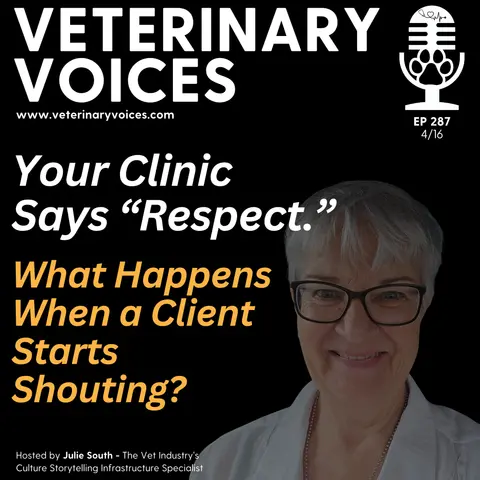
L Is for LIVED VALUES: What Happens When a Client Starts Shouting?
Most veterinary clinics have values.
Respect. Support. Compassion. Teamwork. Wellbeing.
They may appear on the clinic website, in the team handbook or on the lunchroom wall.
But to a vet or nurse considering their next career move, those words are still claims.
Episode 287 is the fourth episode in my 16-part REAL•CULTURE•STORY™ series. REAL•CULTURE•STORY™ is my framework for helping veterinary clinics identify, formulate and test credible clinic culture stories.
In Episode 287, L is for LIVED VALUES. This diagnostic asks whether a clinic’s stated values can be recognised in what people do when those values are tested—especially when honouring a value costs the clinic something. It helps reveal the specific experiences that turn an abstract value into credible recruitment evidence.
Respect on the wall is a claim.
Respect when a client is shouting is culture.
In This Article
Key Takeaways
- The L in REAL•CULTURE•STORY™ stands for LIVED VALUES: recognisable evidence of what happens when a clinic’s values are tested.
- A stated value becomes believable when vets and nurses can see what it changes inside the clinic.
- The clearest evidence often appears when living a value requires a difficult choice.
- Everyday experiences can reveal more about clinic culture than polished recruitment claims.
- Sharing those experiences helps vets and nurses decide whether a clinic could be Their Kind of Clinic.
What Does LIVED VALUES Mean in a Veterinary Clinic?
The LIVED VALUES diagnostic examines whether a clinic’s stated values can be recognised in what people actually do when those values are tested—especially when living the value costs the clinic money, time, convenience, productivity or an easier conversation.
The veterinary clinic involved in this experience lists respect as one of its values.
That tells a vet or nurse what the clinic says matters. It gives them no evidence of what respect looks like when the clinic is beyond busy, a client is angry and a team member is under pressure.
In this genuine experience—shared without identifying the clinic or the people involved—a client began shouting at a receptionist.
The practice manager heard what was happening, came out to support the receptionist and told the client that speaking to a team member that way was unacceptable.
The manager may need to end the clinic-client relationship. The clinic may lose the client’s future revenue. It may receive an angry online review. The conversation itself may be unpleasant.
The manager drew that boundary because protecting the team mattered more than keeping that client.
That experience gives the word respect meaning.
It tells the receptionist that she will be supported. It shows the rest of the team what the clinic will protect. And, when the story is shared, it helps vets and nurses outside the clinic understand what respect means there.
Why Values Become More Credible When They "Cost" Something
The stronger test comes when a clinic must choose between its stated value and another competing priority.
A clinic that says it values wellbeing may close the appointment book when the team has reached capacity, even though accepting more appointments would generate more revenue.
A clinic that says it supports new graduates may give a new vet extra time to work through a case, even though a more experienced vet could complete it faster.
A clinic that says people should speak up may take a nurse’s concern seriously, even when investigating it disrupts the day or creates an uncomfortable conversation.
The cost may be financial. It may be time, convenience or productivity. Sometimes the cost is a difficult discussion that would have been easier to avoid.
When the clinic willingly absorbs that cost, its value becomes credible because people can see what the clinic chose to prioritise.
That is the difference between a value being stated and a value being lived.
What Vets and Nurses Are Trying to Discover
A job ad may catch a vet’s or nurse’s eye. But it’s their own due diligence that determines whether they apply.
Between those two points is the Job Application Decision Gap: the space where vets and nurses research the clinic, compare what it says with what they can find elsewhere and decide whether applying feels worthwhile.
They may want to know:
- What happens when the day becomes beyond busy?
- Will someone step in when a client becomes abusive?
- Can a team member raise a concern and be taken seriously?
- Does “support” include time, backup and practical help?
- Will wellbeing still matter when protecting it affects revenue?
- Do the clinic’s leaders behave consistently with the values on its website?
A list of values cannot answer those questions.
LIVED VALUES can.
A real experience lets vets and nurses see what happened and form their own conclusions rather than accepting the clinic’s description of itself.
Finding Evidence of Your Clinic’s LIVED VALUES
The evidence probably already exists inside your clinic.
Choose one value from your website, team handbook or lunchroom wall. Perhaps it is respect, support, wellbeing or teamwork.
Then ask three people in different roles:
“When have you seen this value shape what someone did here?”
A practice manager may remember closing the appointment book when the team had reached capacity.
A nurse may remember raising a concern and being taken seriously.
A new graduate may remember being given time to work through a case, even though someone more experienced could have completed it faster.
A receptionist may remember a manager stepping in when a client became abusive.
Those experiences reveal what the value means in your clinic. They also reveal how working there could feel for a vet or nurse considering joining you.
Now compare those answers with your current—or most recent—job ad.
Does it contain any of that evidence?
Or has your clinic’s distinctive culture been reduced to the same “respectful, supportive workplace” promised by almost every other veterinary job ad?
Turning a Lived Value Into a Culture Story
Begin with one specific experience:
- What happened?
- Who was involved?
- What did someone do?
- What made that choice meaningful?
- What did the experience show the team member about the clinic?
Keep the people involved at the centre, use their own words where possible and obtain permission before sharing.
The story about the shouting client is not:
We have a respectful and supportive culture.
It is:
When a client began shouting at one of our receptionists, the practice manager came out from the back, stood beside her and made it clear that speaking to a team member that way was unacceptable.
That is evidence.
The vet or nurse reading it can decide what it says about leadership, boundaries and respect inside the clinic.
Giving LIVED VALUES a Permanent Home
A Culture Story Centre gives those stories a permanent, discoverable home where vets and nurses can research the clinic and decide whether it might be Their Kind of Clinic.
Over time, individual stories build a fuller picture of:
- how the team supports one another;
- how leaders respond under pressure;
- what happens when someone needs help;
- how decisions are made;
- and what the clinic’s values change in practice.
During the Job Application Decision Gap, these stories give vets and nurses credible evidence they can use during their own due diligence—whether actively job hunting or keeping an eye out. They can see how the clinic’s values influence real decisions and decide whether it could be Their Kind of Clinic.
Find One LIVED VALUES Story This Week
Choose one value your clinic already claims.
Ask three people:
“When have you seen this value shape what someone did here?”
Listen for a specific experience, especially when living the value required a difficult choice or cost the clinic money, time, convenience, productivity or an easier conversation.
That is the LIVED VALUES test: can the clinic’s stated value be recognised in what someone did when it was tested?
The answer may contain the culture story that helps the right vet or nurse recognise your clinic as Their Kind of Clinic.
Listen to Episode 287 of Veterinary Voices
In Episode 287, I explore L for LIVED VALUES and why a clinic’s values become credible when people can recognise them in what happens when those values are tested.
Listen to the full Veterinary Voices episode.
Frequently Asked Questions
What are LIVED VALUES in a veterinary clinic?
LIVED VALUES are real experiences showing how a clinic’s stated values influence people’s actions and decisions. They give words such as respect, support and wellbeing a specific meaning within that clinic.
Why aren’t clinic values enough on their own?
A value listed on a website or in a job ad tells vets and nurses what the clinic claims. A culture story shows what that value changes when the team is busy, under pressure or facing a difficult choice.
What is the Job Application Decision Gap?
The Job Application Decision Gap is the space between a job ad catching a vet’s or nurse’s eye and their decision to apply. During that time, they conduct their own due diligence and look for credible evidence of what working at the clinic could feel like.
Does a lived value always involve a financial cost?
The cost may be money, time, convenience, productivity or an uncomfortable conversation. What matters is that the clinic’s actions demonstrate which priority it protected when the value was tested.
How can a veterinary clinic find its LIVED VALUES stories?
Choose one stated value and ask people in different roles when they have seen that value shape someone’s actions. Specific experiences—rather than general descriptions—provide the strongest starting points.
What is a Culture Story Centre?
A Culture Story Centre is a permanent, discoverable destination where a veterinary clinic’s real team experiences are brought together. It gives vets and nurses credible evidence to consider while deciding whether the clinic could be Their Kind of Clinic.

Veterinary Recruitment & Culture Storytelling Strategist
Julie South is the founder of VetClinicJobs and the creator of REAL•CULTURE•STORY™ and Culture Story Centres.
Julie started with veterinary recruitment agency VetStaff in 2019. In 2022, she and her husband were offered the opportunity to acquire the business through a management buyout—which they accepted.
In 2025, Julie presented The Modern Clinic’s Guide to Self-Managed Recruitment Success at VET Expo Melbourne and chaired its Technology stream. She was subsequently invited to speak on veterinary employer branding and chair the Business stream at VET Expo Sydney in 2026—an opportunity she declined because of a timing conflict.
Since entering veterinary recruitment, Julie has spoken with clinic owners, practice managers, vets and nurses about what makes a workplace right for some people—and wrong for others.
Those conversations revealed a recurring problem: clinics often know what makes their culture special, but the vets and nurses researching them cannot see it. Julie calls the space between a job ad and an application the Job Application Decision Gap.
Today, she helps independently owned vet clinics turn real experiences from inside their teams into credible recruitment evidence, giving vets and nurses the information they need to decide whether a clinic could be Their Kind of Clinic.
Based in Hamilton, New Zealand, Julie hosts Veterinary Voices for vet clinic owners who want to hire Their Kind of People—and be recognised by them.
U Is for UNDERSTANDING: What Does ‘We Work as a Team’ Actually Mean at Your Veterinary Clinic?