
 Apple Podcasts
 Spotify
 Castro
 RSS Feed
 iHeartRadio
 Does Your Vet Clinic’s Job Ad Sound Like Your Team—or Marketing? ep291
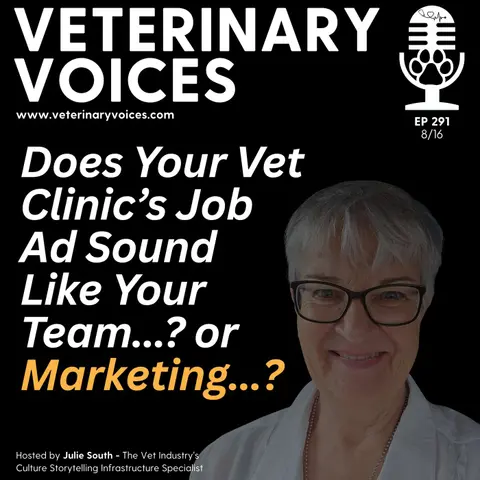
If you removed your clinic’s name and logo from your job ad, would your own team recognise themselves—or could the same words belong to almost any vet clinic?
Vets and nurses want to understand what it would feel like to spend their working week with your people. Phrases such as “close-knit team” and “supportive and collaborative environment” don’t give them that answer. Your team’s real words, humour, warmth, directness and energy can.
Episode 291 is the eighth episode in the 16-part REAL•CULTURE•STORY series.
This week, Julie South explores T for TEAM VOICE: how the genuine language used inside your clinic helps vets and nurses recognise whether these could be Their Kind of People—and why polishing that language out of a job ad can cost you applications.
Previously in this series:
- Episode 284: R for REAL STORIES
- Episode 285: E for EVERYDAY EVIDENCE
- Episode 286: A for ACTUAL PEOPLE
- Episode 287: L for LIVED VALUES
- Episode 288: C for CLARITY
- Episode 289: U for UNDERSTANDING
- Episode 290: L for LIVED VALUES
This episode covers:
- Why so many veterinary job ads sound like every other clinic’s ad
- What Team Voice tells vets and nurses about the people behind a clinic name
- How real phrases such as “Who’s got five minutes and two free hands?” show what support means inside a team
- How job-ad templates and professional-sounding language polish away a clinic’s personality
- The difference between Team Voice and Brand Voice—and how they work together
- Why hearing the real team can help turn interest in a job ad into an application
- The Spot it. Source it. Share it. process for capturing Team Voice without translating it into vanilla recruitment language
Next week, Julie moves to U for UNIQUENESS: what makes your clinic different in a way that the vets and nurses you’d love to hire genuinely care about.
If you’d like help telling your clinic’s Culture Stories—even when you’re not currently advertising a vacancy—email julie@vetclinicjobs.com.
About your host
Julie South is the founder of VetClinicJobs and the host of Veterinary Voices. She has been in veterinary recruitment since 2019 and is known for her work in culture storytelling.
Julie helps forward-thinking vet clinics build the kind of genuine, specific culture evidence that attracts Their Kind of People long before any job ad runs.
She has spoken on culture storytelling and employer branding at VetEXPO in Melbourne and works with clinics across Australasia and the United States who want vets and nurses to be excited about going to work on Monday mornings—for all the right reasons.
Could Your Kind of People recognise Their Kind of Clinic?
A job ad may catch a vet’s or nurse’s eye. But it’s their own due diligence that determines whether they apply—or keep in touch.
Culture Story Centres turn real experiences from inside your team into credible, discoverable recruitment evidence, giving vets and nurses meaningful reasons to choose your clinic.
Explore Culture Story Centres for veterinary clinics
Does Your Vet Clinic’s Job Ad Sound Like Your Team—or Marketing?
Hello and welcome. I’m Julie South, and you’re listening to Veterinary Voices—culture storytelling conversations for vet clinics that want to be found by Their Kind of People: the vets and nurses who genuinely, absolutely can’t wait to start working there.
Veterinary Voices is brought to you by VetClinicJobs, helping clinics give vets and nurses the answers they need to their job application questions before they apply.
This is Episode 291, and it’s the eighth in the series about the REAL•CULTURE•STORY framework. It’s the framework we use when we’re working with clinics to create, tell and share their Culture Stories.
Please stay to the end for this week’s how-to takeaway—how to Spot it, Source it and Share it as a Culture Story from your own clinic.
We’re working through the CULTURE part of the framework, and it helps vets and nurses understand how your clinic works.
Last week—L for LIVED VALUES—we talked about how the accepted behaviour inside a clinic can contradict the values statements pasted on the clinic’s walls. If you haven’t listened to Episode 290 yet, there’s a link in the show notes for you.
What is Team Voice in a veterinary clinic?
This week, T is all about TEAM VOICE.
TEAM VOICE is how your clinic sounds when your people tell its stories in their own words. It’s their language—your language—phrasing, humour, warmth, directness and energy. Whatever your language is.
It’s what helps a vet or nurse who’s outside your team hear the humans behind your clinic name or your clinic logo and think:
“Yes. These sound like My Kind of People.”
And there’s a test for it.
If you removed your clinic’s name or your logo from your job ad, your Careers page and your Culture Stories, would your team recognise themselves? Would they say:
“Yep, that’s absolutely us”?
Or could those same words belong to almost any vet clinic anywhere in your town, your city or your country?
Why do so many veterinary job ads sound the same?
Here are a few phrases you’ve probably seen or heard before, maybe on your clinic’s client website or in your job ads when your clinic’s recruiting:
“We’re a close-knit team.”
“We’re passionate about providing exceptional patient care.”
“We offer a supportive and collaborative environment.”
None of those claims is difficult to understand. The problem is they’re all vanilla. Hundreds of other clinics are saying exactly the same thing.
Those words give a vet or nurse almost no sense of the people they’d be working with. Outsiders are left wondering whether these people—your people—are calm and reserved, warm and chatty, dry and sarcastic, straight-talking or playful.
Would someone check in by asking:
“Are you okay?”
Or would they say:
“You look swamped. What can I take off you?”
Either check-in could come from a supportive team. They sound like two different groups of people.
That difference is all TEAM VOICE.
How can a vet clinic show its real team in a job ad?
The words and phrases your team naturally uses give outsiders clues about how it feels to work with them—to work with you.
Imagine two clinics both say:
“We support each other when things get busy.”
At one clinic, the practice manager says:
“If you’re getting snowed under, tell us early. Nobody gets a medal for drowning on their own.”
Right now, somewhere in a clinic in Minnesota, Manukau or Melbourne, there’s a nurse calling across the treatment area:
“Who’s got five minutes and two free hands?”
That’s the team’s signal that someone’s getting snowed under. Someone takes the bloods, someone else phones the client and someone else finds the food that’s been sitting untouched since lunchtime.
Nobody makes a big performance out of helping. They notice what’s happening and get on with it.
The underlying value may be the same as the first clinic’s. The voice is different. You can hear the people, picture the moment and understand what support means.
That’s the job TEAM VOICE does inside a Culture Story. It helps people understand the humans.
How job ads lose the team’s voice
Most clinics don’t set out to remove their team’s personality. Well, I hope they don’t. They don’t do it on purpose.
It happens during the writing process—and I’m talking about writing job ads here.
Someone starts with a job-ad template. A sentence gets tidied up. The team’s everyday words are replaced with professional-sounding ones. Then the job description is written. Humour gets removed in case someone takes it the wrong way.
By the time the ad’s finished, it’s likely very polished and technically correct. But the people have disappeared. The personality’s gone.
The team that jokes its way through a day that’s turned to custard now “maintains a positive working environment”.
The clinic lead who says, “Grab me before you start second-guessing yourself,” now “provides professional mentorship”.
The meaning’s survived. The voice hasn’t. The voice has been lost.
And the voice is one of the ways vets and nurses recognise Their Kind of People.
What’s the difference between Team Voice and Brand Voice?
Here’s another test for your finished job ad or Culture Story:
Does this sound like Melissa—or Marketing?
Melissa is obviously whoever’s story you’re telling. Would they use these words? Would their workmates recognise them? Or has their humour, warmth or directness been replaced by polished brand language?
Your Brand Voice is the way your clinic chooses to sound publicly. Your Team Voice comes from how the people inside it genuinely speak.
The strongest Brand Voice carries the voices of the people inside the clinic.
Your team may be funny, direct, gentle, energetic, noisy, or calm and measured. The goal is to let the clinic sound like the clinic—like your clinic.
If there’s an in-joke or clinic-specific phrase an outsider won’t understand, give them the backstory so they do understand it—or choose another example.
How does Team Voice affect veterinary job applications?
Okay, Julie, you might be thinking: what’s TEAM VOICE got to do with job applications?
Vets and nurses will understand the hours, caseload, roster and expectations from your job ad. But underneath all of that, they’re likely asking themselves a much more personal question:
“What would it feel like to spend my working week with these people?”
Generic, vanilla recruitment language can’t answer that. It keeps the clinic at arm’s length, and TEAM VOICE is what helps close that distance.
It lets vets and nurses hear enough of the real team to recognise whether you could be Their Kind of People.
Some will hear your team’s directness, humour or energy and decide it doesn’t suit them. Ironically, that’s a good thing.
The vets and nurses who recognise something familiar will lean in closer. They can hear people they might fit with, and that can help turn interest in your job ad into an application.
How can a vet clinic find and share its Team Voice?
I promised you a how-to takeaway. Here’s this week’s for your clinic.
Remember: Spot it. Source it. Share it.
Spot it
Look for a real team moment that shows how your people interact. It could be someone asking for help, the team responding when things get busy, a check-in after a hard case, the way someone welcomes a new starter, or a phrase your team uses when the day begins to turn to custard.
Listen for the words that sound unmistakably, absolutely, 100% like your people. You’ll know the types of words I’m talking about when you turn your ears on and start listening for them.
Source it
Ask the person who was there:
“What was said?”
“What words do you remember?”
“Is there a phrase we use in situations like this?”
Use their words. Please don’t let HR or Marketing translate them into polished recruitment language. That’s not what we’re after.
Obviously, you can remove ums, repeated words or a false start. But keep their vocabulary, keep their phrasing and please keep their personality intact.
If their exact words won’t make sense outside the clinic, give people enough backstory to understand them. If that still doesn’t work, choose another quote.
Share it
Build your Culture Story around their original phrase or the conversation. Give outsiders enough context to understand what was happening and what those words show about your team.
Then read it back to the person who told you the story and ask:
“Does this sound like us?”
If they say, “We’d never say that,” then you haven’t captured the TEAM VOICE yet. Try again. Start again.
Remember: Spot it. Source it. Share it.
Next week: U for UNIQUENESS
Next week, we’re looking at the second U in CULTURE: UNIQUENESS.
Every clinic has routines, people and ways of working that make it absolutely, unmistakably them—that make your clinic absolutely, unmistakably your clinic.
But when you use words like “we’re a family”, “we have a great team” and “no two days are the same”, those words and phrases don’t help your clinic stand out from another 50 or so clinics saying exactly the same thing.
You’re talking vanilla, and we don’t do vanilla in REAL•CULTURE•STORIES.
So next week, we’re going to look at this question:
What makes your clinic different in a way that the vets and nurses you’d love to hire genuinely care about?
If you’d like help telling your team’s Culture Stories in a way that turns vanilla into something absolutely meaningful, then let’s have a chat—even if you’re not trying to fill a vacancy at your clinic right now.
Because Culture Storytelling needs to be an always-happening thing, not just something you do when you’re advertising a job vacancy.
Please get in touch: julie@vetclinicjobs.com.
This is Julie South signing off and inviting you to go out there and be your most fantabulous self—because you work in Your Kind of Clinic with Your Kind of People.
Until next week.